
Why a bigger bonus can make you worse at your job
Researchers in India offered villagers up to a month's spending to win simple games. What the biggest prize did, and when big rewards help or hurt.
Most of us believe something about pay without ever saying it out loud. If you want someone to try harder, offer more. If you want their very best, offer a lot.
In 2002, a team of economists and psychologists tested that belief in a village near Madurai, in southern India, with prizes big enough to change a family’s year. The result was awkward enough that people still argue about it.
It also explains why the moment that matters most is so often the moment we fumble. An interview, an exam, the one pitch that decides the year. Let’s start in the village.
A month’s spending on one game
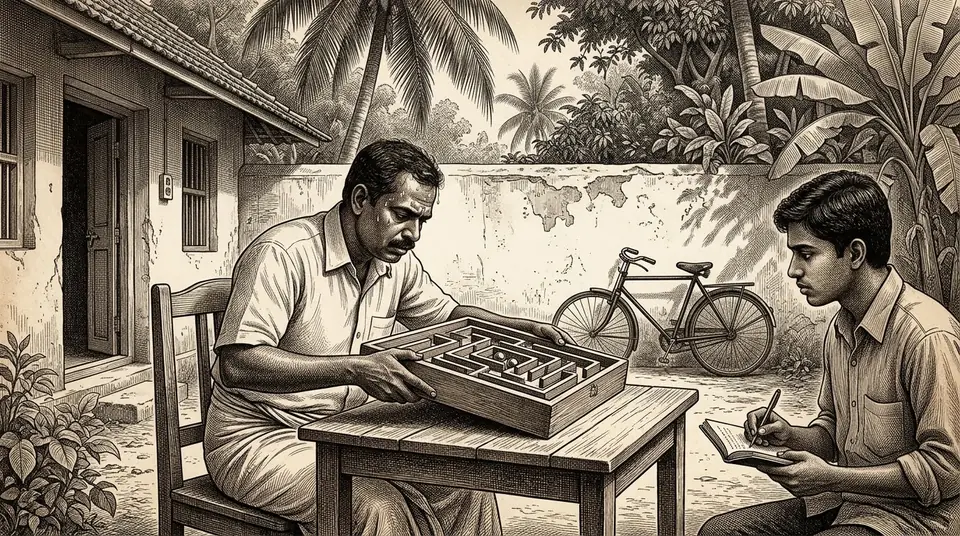
The team recruited 87 people from the village, working with local research assistants. One at a time, each player sat down to six simple games. One was a wooden labyrinth you tilt to steer a ball past the holes. Another was a memory game of flashing lights, and another meant tossing tennis balls at a target.
Every player was told what a good score and a very good score would earn. The catch was the size of the prize. One group could win 4 rupees a game, another 40, and the third 400.
Four hundred rupees was close to what a person in rural India spent in a whole month. A player who did very well at all six games would take home about half a year’s spending. These were people with five or six years of schooling on average, and about half of them owned a TV.
So who played best? Most people guess the group with the most to win. Make your own guess, then open the box.
Which group played best?
Not the 400-rupee group. It did the worst of the three, by a wide margin.
The two smaller-prize groups won about 36 percent of what was on offer. The players chasing a month’s spending per game won 19.5 percent.
You’ve felt this from the inside
If you’ve ever blanked on an easy question in an exam you’d revised for, you already know what happened in that courtyard. When the stakes climb high enough, attention turns inward. You stop watching the ball and start watching your own hands.
Psychologists call it choking. A skill that normally runs on its own gets interrupted by a mind that’s suddenly checking every move, and the checking is what breaks it. A month’s spending riding on one tilt of a wooden board is exactly the kind of pressure that does it.
The researchers wanted to be sure it wasn’t something about the village, so they ran a second test at MIT in the United States. Twenty-four students did two tasks for money, each with a small prize and a prize ten times bigger.
One task was pure effort: pressing two keys in turn, as fast as possible, for four minutes. The other took a little thought: finding the two numbers in a grid that add up to ten.
On the key-pressing, the bigger prize roughly doubled their score, from 40 to 78 percent of what they could earn. On the adding, the same students fell from 63 to 43 percent when ten times more money was riding on it.
Twelve yards, and a whole country watching
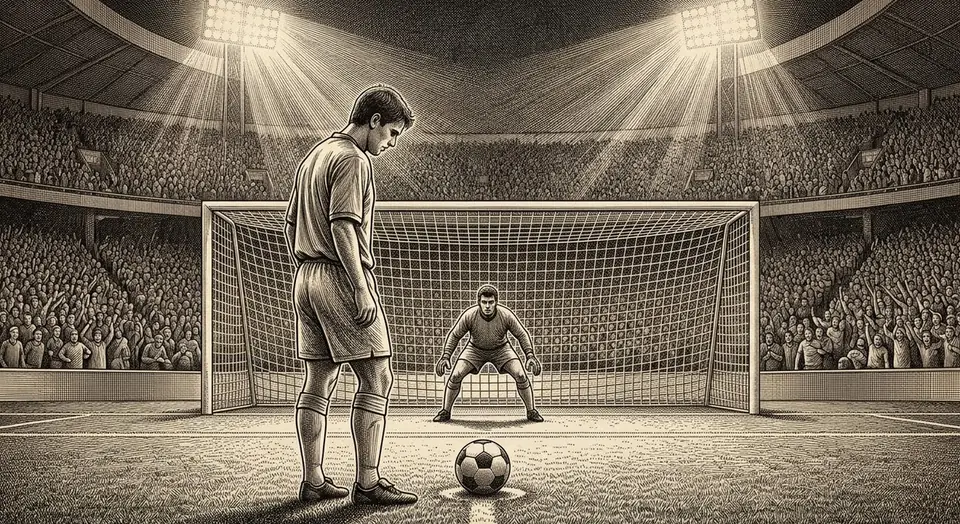
The same thing happens on the biggest stages in sport. In a football penalty shootout, each kicker gets one shot from twelve yards with only the goalkeeper to beat, and professionals score most of them.
The Norwegian psychologist Geir Jordet went through every shootout at the World Cup, the European Championship and the Champions League up to 2006. That came to 36 shootouts and 359 kicks.
He sorted the kicks by what was riding on them. Some players could win the shootout with a goal, while others would lose it on the spot if they missed.
Same twelve yards, same kind of player. Guess which kicks went in more often.
Which kicks went in more often?
The kicks that could win it went in about 92 percent of the time. The kicks that could lose it, about 62 percent.
The players facing defeat behaved differently, too. They were more likely to look away from the goalkeeper and rush their preparation, as if they wanted the moment over with. It’s the courtyard in Madurai with a stadium around it: the more a miss would cost, the worse the skill held up.
Hands get faster, heads get worse
That split is the useful part. Money is good at buying effort, and effort is what simple, repetitive work needs: more boxes packed, more keys pressed, more calls made. It’s much worse at buying a clear head, which is what most interesting work needs.
Yet our biggest rewards tend to hang on single moments. A bonus that rides on one deal, a commission on one pitch, a promotion decided by one review, a whole year of school riding on one morning’s exam.
We put the highest stakes on exactly the moments that need a calm mind. Then we wonder why people freeze or play it safe or, when the reward is tied to a number, start farming the number.
How to raise the stakes without breaking the player
None of this means paying people less. It means being careful about where the money lands.
For routine, mechanical work, a reward for output mostly helps. For work that needs judgement, keep any single moment from carrying too much. Spread a big reward over many decisions instead of one, so that no single pitch or exam decides everything.
If the big moment is yours, shrink it before you walk in. Rehearse under mild pressure so the real thing feels familiar, and remind yourself it’s one chance among many. That’s the usual advice for choking, and the Madurai results show why.
And when someone fumbles a moment that matters, don’t assume they didn’t care enough. In that courtyard, the players who did worst were the ones with the most to gain.
After a bounty that bred cobras, a fine that made parents later and a prize that made players worse, you might wonder whether paying for results ever works. It does, and sometimes brilliantly. One American company paid its installers per windshield, and output jumped by about 44 percent.
Sources
- Dan Ariely, Uri Gneezy, George Loewenstein and Nina Mazar, “Large Stakes and Big Mistakes”, Review of Economic Studies 76, no. 2 (2009), pp. 451–469.
- Geir Jordet and Esther Hartman, “Avoidance Motivation and Choking Under Pressure in Soccer Penalty Shootouts”, Journal of Sport & Exercise Psychology 30, no. 4 (2008), pp. 450–457.
- The pictures are our own illustrations, not archive images.
Prefer to watch?
Each of our films follows one story like this to the moment it turned.
More from Incentives & Game Theory
The Cobra Effect: why smart people pay for the wrong thing
Why paying for results so often backfires: Delhi's cobras, Hanoi's rat catchers, a bank's fake accounts, and the question that catches it in ten seconds.
Why fines backfire: the daycare that made parents later
A daycare fined parents who came late and got more late parents. What a fine, a fee or a payment can quietly switch off, and how to keep it on.